
Unique Buddha statues in some Asian countries
Buddha statues are clear evidence of Buddhist culture in each region and each country. Each country has its own Buddhist cultural nuances with characteristics, expressed through religious architecture, forms of worship and the art of creating statues. The Ho Chi Minh City Museum of History is displaying Buddhist statues from some Asian countries, attracting the interest of domestic and foreign tourists.
According to the Ho Chi Minh City Museum of History, from the 1st-3rd century BC, Buddhism was developed by Indian monks through the Silk Road to the North through Central Asia to China, Vietnam, Korea and Japan with the Northern sect (Mahayana); to the South to Sri Lanka, countries in the South Asia and Southeast Asia regions such as: Myanmar, Thailand, Cambodia, Laos… with the Southern sect (Theravada Buddhism).
Vietnam
Buddhism entered Vietnam around the 2nd century BC by sea from the South and by land from the North. The system of statues worshiped on the Buddha halls in Vietnamese pagodas with many images such as: Sakyamuni, Bodhisattva, Arhat… has a unique style, showing the adaptation between Buddhism and indigenous beliefs.
The Ho Chi Minh City Museum of History is displaying many Buddha statues in pagodas in Vietnam, including a very valuable statue, the Buddha statue of Khai Tuong Pagoda with a large size made of gilded wood.
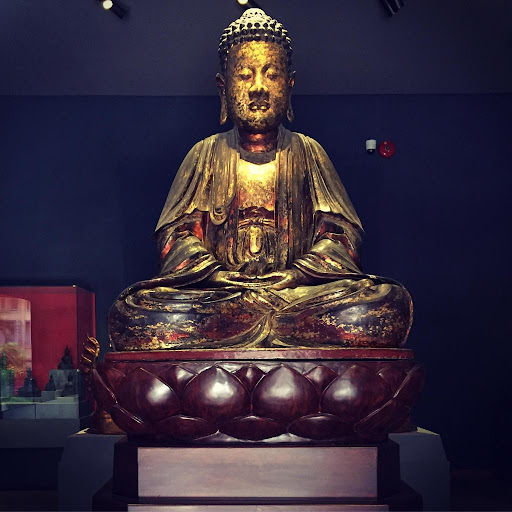
According to the museum’s annotation, this is a Buddha statue sitting cross-legged on a wooden lotus throne donated by King Gia Long (1820-1840) on the inauguration day of Khai Tuong Pagoda to show gratitude for the Buddha’s protection of the king and his mother during the war. Khai Tuong Pagoda was originally located in the Duoi market area, Gia Dinh province. In 1859, after the French colonialists captured Gia Dinh citadel, the pagoda was completely destroyed and this Buddha statue is one of the few remaining relics.
China
When talking about Buddhism, we cannot help but mention China – one of the major Buddhist centers. Buddhism was introduced to China around the 1st-2nd century BC along the Silk Road. Chinese Buddhist sculptures are a combination of the process of exchange with other Buddhist centers. From the end of the 6th century to the 10th century, Chinese Buddhist sculpture developed strongly with distinct anthropological and ethnological characteristics.
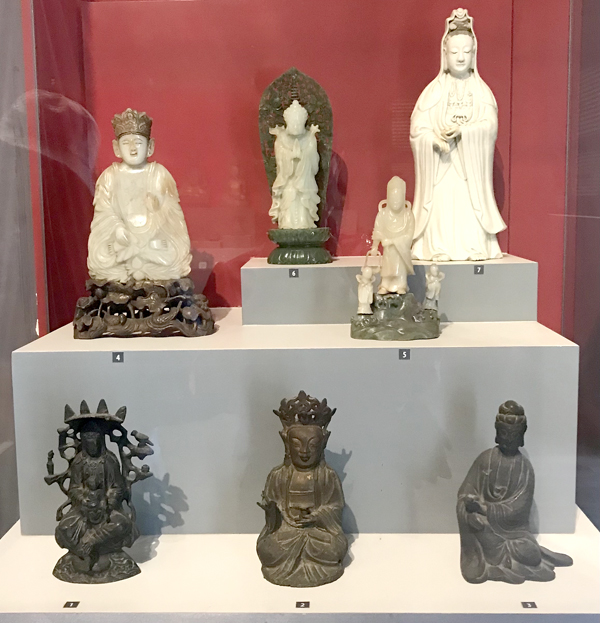
In Chinese Buddhist temples, the image of Bodhisattva, especially Quan The Am, occupies an important position. In China, Vietnam and some other countries, Quan Am is worshiped as a compassionate Buddha with the shape and costume of a dignified and beautiful mother.
Japan
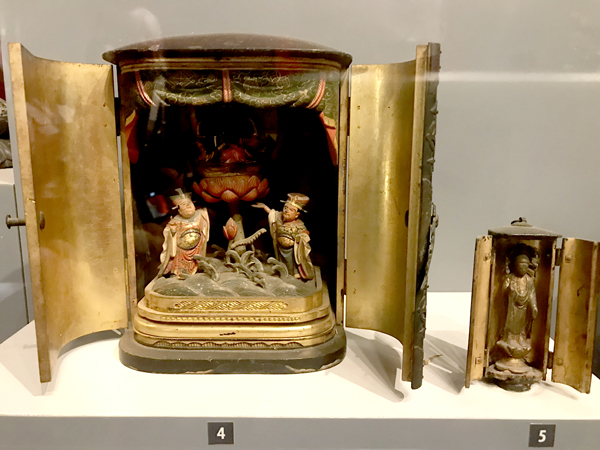
An important event that had a lasting impact on the development of Japanese thought, art, and culture was the introduction of Buddhism from Korea to Japan around the 6th century. When Buddhism was popular in Japan, art developed strongly and changed through historical periods.
Among Japanese Buddhist statues, the most prominent is the altar (Butsudan) – an object used for worship in temples, which first appeared with the introduction of Buddhism to Japan around the 6th century. The altar is made like a miniature temple, which can be easily carried. Inside the altar is a statue of Chuẩn Đề sitting on a lotus throne, with two servants in ancient Japanese costumes below.
Thailand
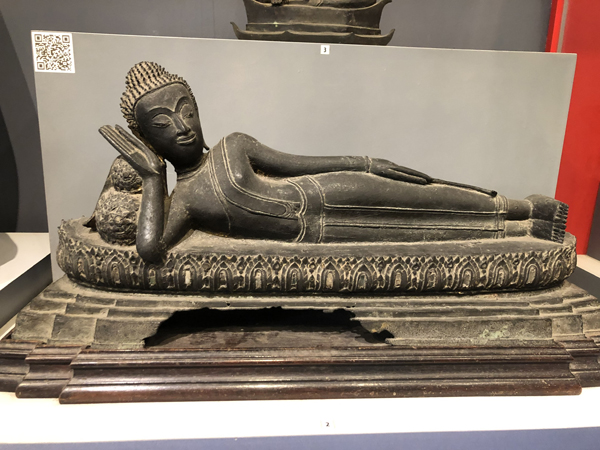
The Buddha statue of Thailand is made of bronze, dating from the 15th century. The statue depicts the image of Shakyamuni entering nirvana. The statue wears a monk’s robe with the right shoulder exposed, the hem of the robe runs down to the feet, lying on the right side, on a pedestal carved with lotus flowers; the left arm is placed along the left leg, the right hand is bent and the hand is supported by the right cheek; the head is placed on a two-tiered pillow decorated with patterns, the eyes are closed, the appearance is peaceful and serene…
Cambodia
The Buddha statue of Cambodia dates back to the 19th century, made of gilded wood. The statue depicts the Buddha having attained enlightenment in a cross-legged sitting position on a pedestal. The statue’s head wears a multi-tiered pointed hat symbolizing the authority of the Great Enlightened One.
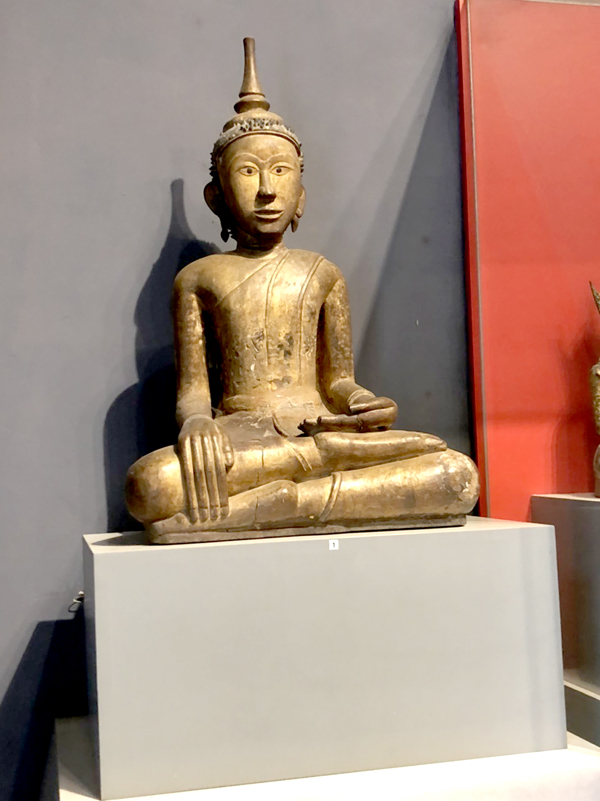
The statue’s face has a wide forehead, eyes looking straight, long arms with pearls flowing down – one of the noble features of the Buddha. The statue’s body is wearing a monk’s robe draped over the left shoulder, the right shoulder and right arm are bare. The right arm hangs down along the hip and the hand is placed on the right leg, the 5 fingers are placed down, the left arm is stretched out and placed face up on the thigh.
In Southeast Asian countries, Buddhism spread around the 2nd century BC but Buddhist sculptures appeared later (around the 5th-6th century) in coastal areas such as Myanmar, Thailand, Cambodia, Vietnam and Indonesia. The lotus sitting posture is a cross-legged sitting posture originating from ancient Indian meditation practice, with the foot placed on the opposite thigh.